
Why Your Low Back Hurts After Sitting All Day (And What a Chiropractor Can Do About It)

It's 4pm. You've been at your desk since around 8, maybe with a quick break for lunch, and somewhere around the third hour your low back started quietly complaining. Now it's a dull, persistent ache. You shift in your chair. You stand up and feel that familiar stiffness. You walk to the kitchen, and after a minute or two it loosens up a little, so you sit back down. And then it starts again.
If that pattern sounds familiar, you're in very good company. Sitting-related low back pain is one of the most common reasons people walk through a chiropractor's door, and it's also one of the most commonly dismissed. People assume it's just part of having a desk job, something to manage with ibuprofen or a better chair rather than something worth actually addressing.
Here's the thing: there's a real mechanical reason your back hurts after sitting all day. It's not mysterious, and it's not inevitable. Your spine is doing something specific under sustained load, your muscles are responding in a predictable pattern, and over hours, those small stresses add up. Understanding what's happening is the first step toward doing something about it.
This article will walk you through the mechanics of sitting-related low back pain, explain why it tends to get worse as the day goes on, help you figure out when it's worth getting evaluated, and describe what a chiropractor actually does about it. If you've been living with recurring low back stiffness and telling yourself it's just normal, this is worth a few minutes of your time.
What's Actually Happening in Your Spine When You Sit
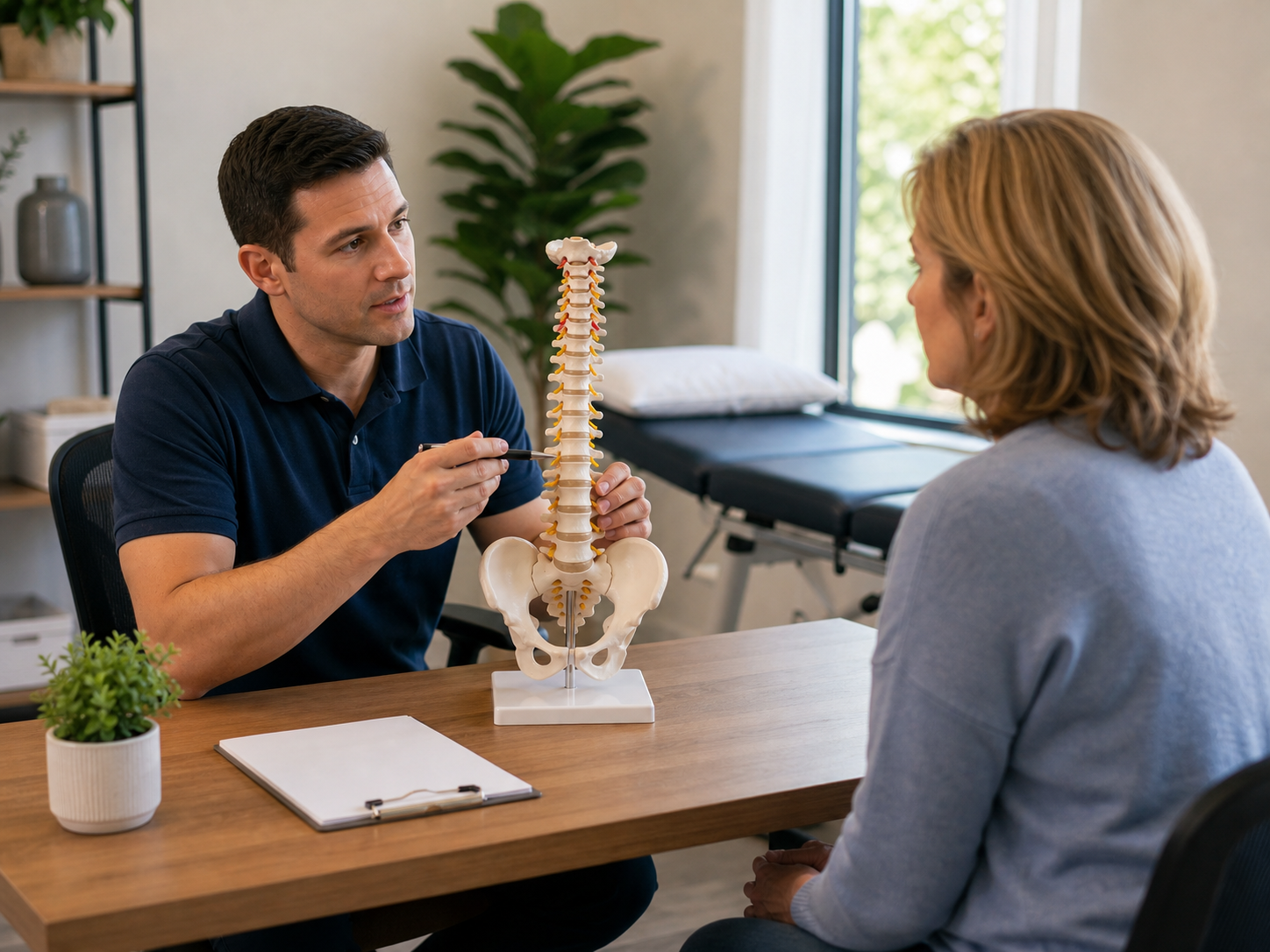
Your lumbar spine, the lower portion of your back, has a natural inward curve called lordosis. That curve isn't just aesthetic. It's the spine's way of distributing load efficiently, spreading compressive forces across the discs and the surrounding structures in a way that's sustainable over time. When you sit, especially for extended periods, that curve tends to flatten. And when the curve flattens, the load shifts.
Instead of being distributed across the disc in a relatively balanced way, the compressive force moves toward the back portion of the disc, the posterior annulus, and onto the facet joints. These structures can tolerate that load for a while. But over hours, in a position the spine wasn't really designed to hold indefinitely, the cumulative stress starts to register as discomfort.
There's also a muscle story happening at the same time. When your hips are bent at roughly 90 degrees for most of the day, the hip flexors, a group of muscles that run along the front of your hips and connect to the lumbar spine, stay in a shortened position. Over time, they adapt to that shortened state and become less flexible. This is a gradual process, not something that happens in a single workday, but for someone who sits for most of their waking hours, it builds.
Shortened hip flexors pull the front of the pelvis downward, tilting it forward in what's called an anterior pelvic tilt. When the pelvis tilts forward, the lumbar spine is pulled into more extension, which increases compression on the posterior structures of the spine. It's a chain reaction that starts at the hips and ends in the low back.
On the other side of that equation, the glutes, which are supposed to counterbalance the hip flexors and stabilize the pelvis, tend to become underactive in people who sit for long stretches. Some clinicians describe this as a kind of functional amnesia, where the muscles simply stop contributing as much as they should because they're not being asked to work. When the glutes aren't pulling their weight, the lumbar muscles have to compensate, and that overactivation contributes to the aching and fatigue you feel by the afternoon.
Add in the postural habits most desk workers develop without thinking about it, the slight forward lean, the head inching toward the screen, the lower back losing contact with the chair back, and you have a picture of sustained mechanical stress that accumulates over the course of a workday. None of it is dramatic. It's just a lot of small things adding up over a lot of hours.
Why the Pain Tends to Peak Late in the Day
If you've noticed that your back feels reasonably okay in the morning but becomes noticeably worse by 3 or 4pm, that's not a coincidence. There's a fairly straightforward explanation for why sitting-related low back pain follows that pattern.
The spine tolerates sustained load reasonably well at first. Early in the day, your discs are well-hydrated, your muscles are relatively fresh, and your posture is probably at its best. But the discs in your lumbar spine are avascular, meaning they don't have a direct blood supply. They rely on a process called imbibition, essentially absorbing fluid and nutrients through movement and pressure changes, to stay healthy. When you sit for hours under sustained compressive load, that fluid exchange is reduced. The discs lose a small amount of hydration and height over the course of the day, and the surrounding tissues can become more sensitive as a result.
This is also why many people feel noticeably better in the morning after a night of lying down. The reduced load while you sleep allows the discs to rehydrate. Then the cycle starts again.
There's also a fatigue component that accelerates the problem in the back half of the workday. Your core and paraspinal muscles, the ones responsible for holding you upright and supporting the lumbar spine, have been working steadily since you sat down. As they tire, your posture tends to collapse. The lower back rounds, the pelvis tucks under, and the load on the posterior disc increases further. Most people don't notice this happening because it's gradual, but if you pay attention to how you're sitting at 9am versus 4pm, the difference is usually pretty significant.
The combination of disc sensitivity from cumulative compression, muscle fatigue, and progressive postural collapse explains why that end-of-day ache feels different from morning stiffness. Morning stiffness is often about the spine waking up and redistributing fluid after a night of rest. End-of-day aching is the accumulated result of hours of mechanical stress. They're related, but they're different experiences with slightly different drivers.
Figuring Out Whether Your Back Needs Professional Attention
Not every sore back after a long day at the desk requires a clinic visit. Some discomfort is genuinely postural and responds well to movement, position changes, and better habits. But there's a meaningful difference between that and a pattern that keeps coming back and hasn't actually resolved.
Signs that your back pain is likely postural and mechanical, and lower urgency, include pain that eases fairly quickly after you stand up and move around, a dull, diffuse ache that's roughly symmetrical on both sides of the lower back, and a gradual onset that correlates with a job change, a more sedentary stretch, or spending more time at a desk. If the pain is predictable, movement-responsive, and doesn't extend beyond your lower back, it's usually in the category of something that can be addressed with the right approach.
There are symptoms, though, that warrant prompt evaluation rather than a wait-and-see approach. Pain that radiates down one leg, especially if it follows a specific path from the buttock into the thigh, calf, or foot, may indicate nerve involvement, and sciatica is worth ruling out rather than assuming it will resolve on its own. Numbness or tingling in the feet or toes is another signal to take seriously. Pain that wakes you from sleep, or that feels worse lying down than it does sitting or standing, can sometimes point to something that needs a closer look. And if your back pain started after a specific fall, accident, or injury, that context matters and should be evaluated.
The middle ground is where most desk workers actually live, and it's the group that often waits the longest before getting help. This is the person whose back stiffens up every few weeks, who manages it with stretching or over-the-counter pain relief, who feels better for a bit and then has it come back. The pattern itself is the signal. Recurring low back stiffness that keeps returning suggests the underlying mechanics haven't been addressed, and that's precisely the kind of situation where a chiropractic evaluation tends to be most useful. Not because something is seriously wrong, but because the cycle isn't going to break on its own.
If you're somewhere in that middle ground, and you've been quietly managing rather than actually addressing it, that's worth reconsidering.
How a Chiropractor Evaluates and Addresses Sitting-Related Low Back Pain
One of the things that holds people back from booking a chiropractic visit is not knowing what to expect. If you've never been to a chiropractor, or if your only reference point is a quick adjustment you saw in a video, it's worth understanding what the actual process looks like for someone coming in with desk-related low back pain.
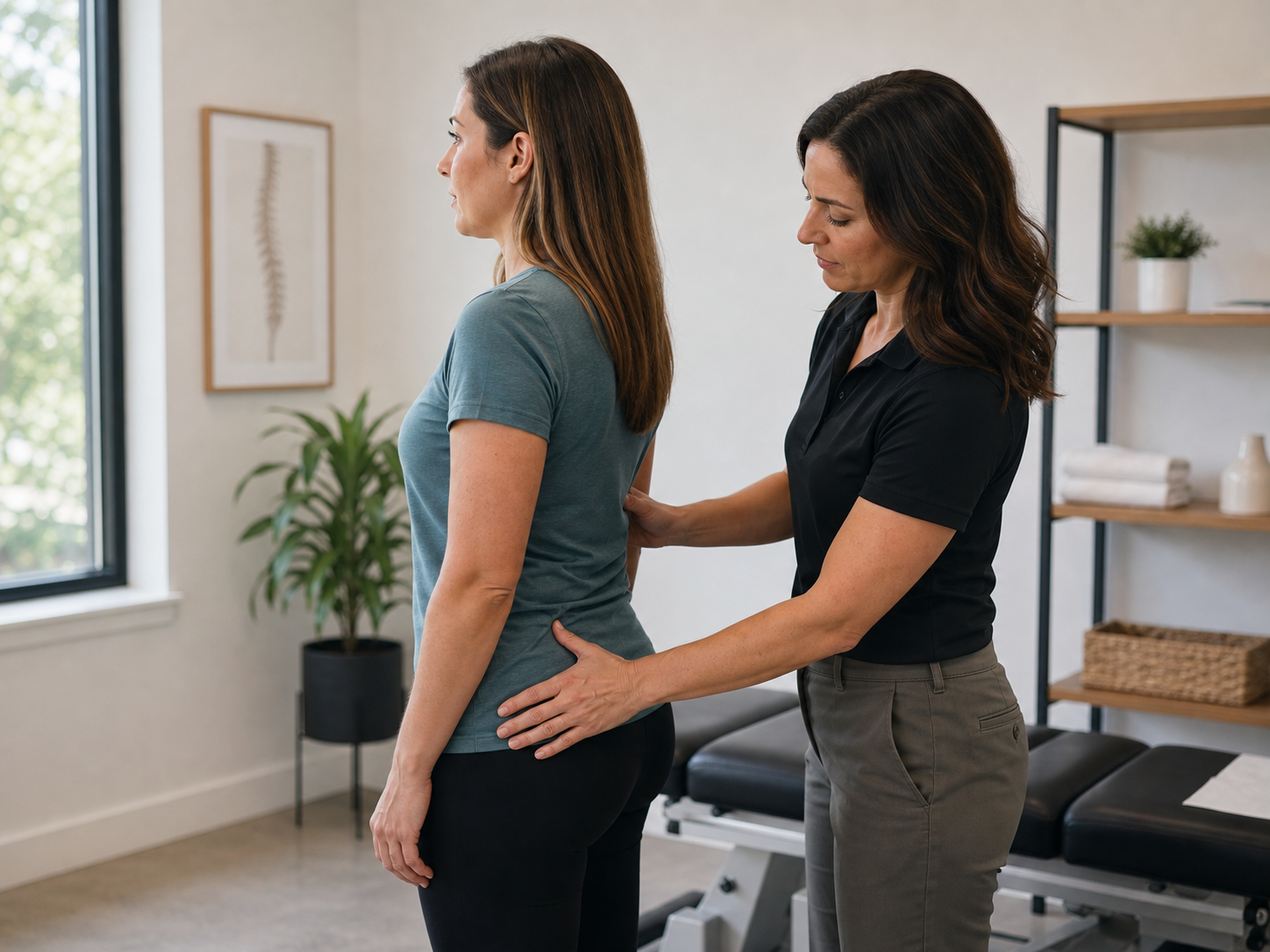
The first visit at Innovate Health typically begins with a thorough conversation about your history: when the pain started, what makes it better or worse, what you've already tried, and what your daily routine looks like. That context matters. A chiropractor isn't just treating a painful area; they're trying to understand the mechanical pattern that's driving it.
From there, a postural and movement assessment gives the provider a clear picture of how your spine is actually functioning. This might include observing how you move through bending and rotation, assessing the position of your pelvis, and palpating the lumbar spine and surrounding muscles to identify areas of restriction, tenderness, or asymmetry. It's a hands-on, observational process, not an imaging-first approach.
Spinal adjustments for lumbar joint restriction address something specific: segments of the spine that have lost their normal range of motion. When a joint becomes restricted, the surrounding tissues can become irritated and the mechanics of the whole region are affected. An adjustment applies a precise, controlled force to restore mobility to that segment. The goal is to help the spine move more normally and distribute load more efficiently. It's not about forcing anything; it's about restoring what should already be there.
Adjustments are often one part of a broader care plan. Soft tissue work addresses the muscle tension and trigger points that build up in the lumbar region and hips after prolonged sitting. Targeted stretching guidance helps you address the hip flexor tightness and glute underactivation that contribute to the problem between visits. Ergonomic recommendations give you practical adjustments to make at your workstation so the same pattern isn't being reinforced for eight hours a day.
Massage therapy can also be a helpful complement to chiropractic care, particularly for patients whose low back pain involves significant muscle tension alongside joint restriction.
It's also worth knowing that chiropractic care for mechanical low back pain is recognized by major clinical bodies, including the American College of Physicians, as a first-line, non-pharmacological option. This isn't fringe care. It's an evidence-informed approach that belongs in the conversation alongside other treatments.
What You Can Do Right Now, Before or Between Visits
There are a handful of habits that genuinely support lumbar health for desk workers, and none of them require a gym membership or a complete lifestyle overhaul. They're practical, evidence-informed, and worth starting today.
Movement breaks every 30 to 45 minutes: This is probably the single most impactful thing you can do. Standing up and walking for even two to three minutes resets the compressive load on your lumbar discs, activates the glutes briefly, and interrupts the postural collapse that builds over long sitting stretches. You don't need a standing desk or a special routine. You just need to get up regularly. Setting a timer is genuinely useful here because most people lose track of time when they're focused on work.
Hip flexor stretching: A simple kneeling hip flexor stretch, where you drop one knee to the floor and shift your weight forward until you feel a stretch at the front of the hip, can help counteract the shortening that happens from hours of sitting. Holding it for 30 to 45 seconds on each side, done consistently, is more valuable than a longer session done occasionally. The goal isn't dramatic flexibility; it's maintaining the range of motion you already have.
Glute activation: Exercises like bridges, where you lie on your back with knees bent and lift your hips off the floor, ask the glutes to do their job in a controlled way. This is less about building strength and more about re-establishing the neuromuscular connection that sitting tends to quiet down. Even a few minutes of this daily can help address the compensatory lumbar overactivation that contributes to end-of-day aching.
Lumbar mobility work: Gentle movements like cat-cow, where you alternate between arching and rounding the lower back on hands and knees, help restore normal movement to a spine that's been held in one position for too long. This works well as a morning routine or as a mid-day reset.
On the ergonomic side, the highest-leverage adjustments are lumbar support in your chair, screen height positioned so your eyes meet the top third of the monitor without looking down, and feet flat on the floor or a footrest. These three things address most of the postural load that compounds over a workday. You don't need to overhaul your entire setup; you just need the basics to be right. For a more complete picture of how integrating holistic wellness habits can support your overall health, that broader context is worth exploring as well.
If the discomfort no longer stays in your back and instead travels into one leg, read why sciatica can hurt more when you sit, what position changes may help, and which nerve symptoms deserve an evaluation.
Getting a Real Answer at Innovate Health in Grapevine
Recurring low back pain from sitting is common. But common doesn't mean you have to just live with it indefinitely. If your back has been stiffening up regularly, if you've been managing it rather than actually addressing it, or if you've been wondering whether chiropractic care is even the right fit for your situation, getting a professional opinion is a reasonable next step.
At Innovate Health in Grapevine, the starting point for most new patients is a free 15-minute Discovery Call. It's a low-pressure conversation with the team where you can describe what you're experiencing, ask questions about what care might look like, and get a sense of whether coming in for a full evaluation makes sense. There's no obligation, and it's specifically designed for people who are a little unsure, whether that's because they've never seen a chiropractor before, they're not sure their situation is serious enough, or they just want to understand what they're getting into before they commit to anything.
One thing that keeps a lot of people from seeking care is the assumption that it won't be covered by their insurance. Innovate Health is in-network with most major insurance carriers, which means cost is often less of a barrier than people expect. If you've been putting off getting evaluated because you weren't sure what it would cost, it's worth checking. You can learn more about how insurance works for chiropractic care on the Innovate Health website.
The care at Innovate Health is integrative, which means chiropractic, functional medicine, and other services can work together in a coordinated plan rather than in isolation. For sitting-related low back pain, that combination often addresses the problem more completely than any single approach on its own.
Putting It All Together
Think back to that 4pm moment. The aching, the shift in the chair, the brief relief when you stand up. Now you know what's behind it: compressed lumbar discs, shortened hip flexors, underactive glutes, postural collapse from muscle fatigue, and hours of sustained mechanical load on a spine that wasn't designed for that position indefinitely.
None of that is catastrophic. But none of it resolves on its own if the underlying mechanics stay the same. Movement breaks help. Stretching helps. Better ergonomics help. And when the pattern keeps coming back despite those efforts, that's the signal that something in the mechanics needs to be evaluated and addressed more directly.
You don't have to keep managing this quietly. A chiropractor can assess what's actually going on in your lumbar spine, address the joint restrictions and muscle imbalances that are driving the problem, and give you a practical plan for keeping it from coming back. That's not a promise of a cure. It's a realistic description of what good chiropractic care actually does.
If you're in the Grapevine area and ready to stop just coping with it, the easiest first step is a conversation. Schedule a free 15-minute Discovery Call with the Innovate Health team and find out what's actually going on with your back.

Here's the latest
Get insights from our office on the latest treatments, trends and topics.


What Our Patients Say About Dr. Payne
.svg)

Ready to take the first step?
Let us guide you on your wellness journey. Book an in-office visit or schedule a phone consultation with the doctor, today. Choose your path below.
.webp)